Kawaii Animals Coloring Book for Kids: A Creative Asset Analysis
When we talk about visual communication, we often focus on professional typography—serif fonts for authority or sans serif fonts for clarity. However, for a specific demographic—children ages 3 to 7—typography takes a backseat to illustration and form. The Kawaii Animals Coloring Book for Kids represents a distinct category of design asset. It is not a typeface in the traditional sense, but rather a curated collection of vector-based illustrations designed for the publishing and educational markets. For designers and entrepreneurs, understanding the utility of this specific style—Kawaii—is crucial for tapping into the lucrative children’s activity market.
The Visual Language of Kawaii
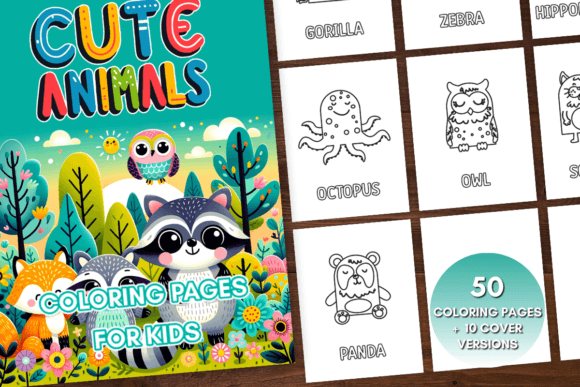
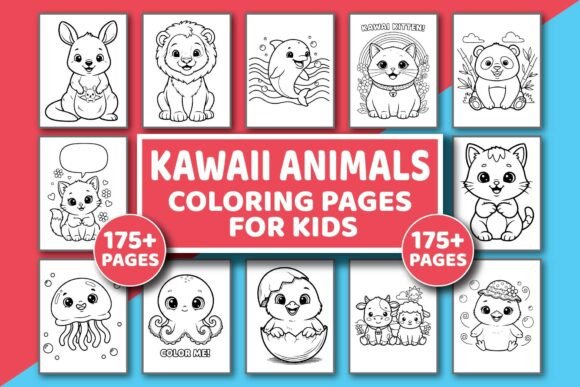
The term "Kawaii" translates to "cute" in Japanese, but in design terms, it implies a specific aesthetic characterized by softness, innocence, and simplicity. The Kawaii Animals Coloring Book for Kids bundle relies on this visual language to achieve its goals. The illustrations typically feature oversized heads, large expressive eyes, and rounded body shapes. This design choice is intentional; it bypasses the "uncanny valley" that realistic animal drawings might trigger in toddlers, replacing it with a non-threatening, friendly presence.
From a technical perspective, the assets are constructed with bold, thick outlines. This is a critical design decision for the target age group (3–7). Young children are still developing fine motor skills; thin, intricate lines often lead to frustration and coloring "outside the lines." By utilizing high-contrast black outlines against white space, the designer ensures that the child experiences success, which encourages further engagement. The "minimal details" approach mentioned in the product description is not a lack of effort, but a deliberate exercise in restraint—focusing on the essential shape of the animal (a bear, a cat, a bunny) without overwhelming the user.
Strategic Applications for Designers and Publishers
While the immediate application seems obvious—printing pages for a child to color—the versatility of the Kawaii Animals Coloring Book for Kids extends into various commercial and creative projects. For publishers, these assets are the foundation of "low-content books." On platforms like Amazon KDP (Kindle Direct Publishing) or Creative Fabrica, coloring books remain a steady seller. The challenge for a designer is not just uploading the pages, but creating a compelling cover that utilizes these illustrations to stand out in a crowded marketplace.
Beyond the physical book, these assets serve as modular components for broader brand identity projects targeting the parenting sector. Consider a daycare center or a pediatric dentist. Their branding needs to be approachable. Using these Kawaii animals in packaging design for children’s snacks, or as mascots in web design for educational apps, can significantly soften the user experience. The illustrations can be adapted into social media graphics for parenting bloggers, creating a consistent, cheerful aesthetic that drives engagement.
Furthermore, the bundle is ideal for editorial design. A magazine article discussing "Rainy Day Activities" or "Screen-Free Play" could use these illustrations as spot graphics to break up text and add visual interest. The simplicity of the style allows them to sit comfortably alongside various font pairings, whether you are using a playful script font for headers or a clean sans serif font for body copy.
Evaluating Quality and Usability
When sourcing design assets, quality control is paramount. A "high-quality" coloring page implies high resolution (usually 300 DPI) and clean vector paths. If you are purchasing the Kawaii Animals Coloring Book for Kids for commercial use, you must verify the licensing. Can you modify the animals? Can you use them on print-on-demand merchandise like t-shirts or mugs? These are the practical questions that separate a hobbyist from a professional entrepreneur.
For the end-user—the child—the success of the product lies in the "happy expressions" and "non-scary" design. Psychologically, children respond to facial symmetry and positive emotional cues. The illustrations in this bundle are designed to elicit a smile, fostering a positive association with the activity of coloring. This emotional connection is what parents are actually buying when they purchase a coloring book; they are buying a moment of peace and a positive developmental experience for their child.
Integrating Kawaii Style into Your Workflow
For the creative professional, the Kawaii Animals Coloring Book for Kids is more than just a set of pictures; it is a study in audience-appropriate design. It teaches us that complexity is not always the goal. Sometimes, the most effective design is the one that is easiest to consume. Whether you are building a product line for Etsy, designing a user interface for a kid's tablet, or publishing your first activity book, these assets provide a reliable, tested foundation.
The key takeaway is the balance between aesthetic appeal and functional utility. The bold outlines serve the motor skills; the cute faces serve the emotional connection; the simple shapes serve the cognitive development of the 3–7 age range. By leveraging these specific characteristics, you can create products and designs that are not only visually appealing but also deeply functional for their intended audience.